
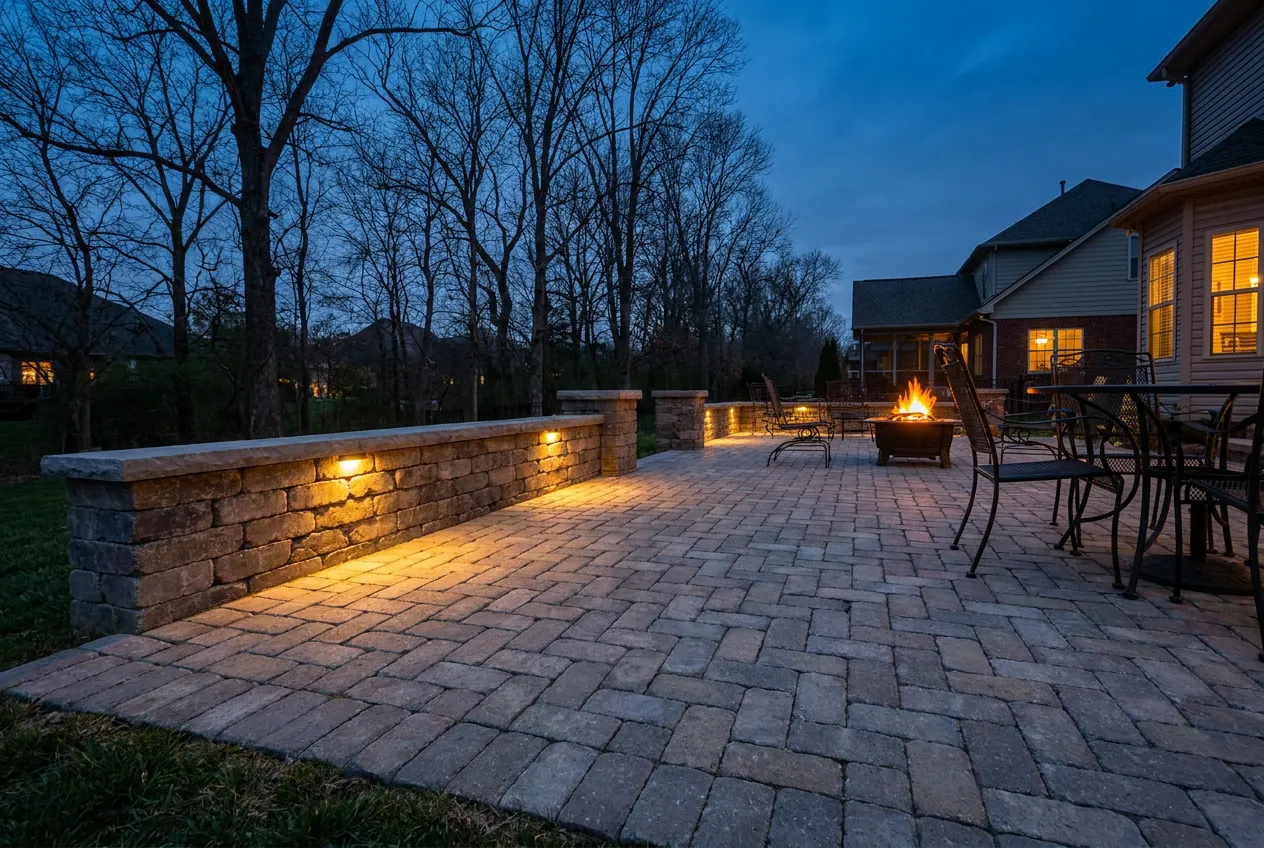
What goes under a paver patio?
Four inches of compacted crushed stone, at minimum, is what the Concrete Masonry & Hardscapes Association (CMHA, which now publishes the old ICPI technical notes) calls for under a patio or walk on well-drained soil. On top of that goes about an inch of bedding sand, screeded flat and left loose until the pavers are set into it. Clay soils and wet spots need more base, never less.
The finished surface falls at least 1.5 percent away from the house, which works out to a little under 2 inches over 10 feet. NOAA’s 1991–2020 normals put 50.5 inches of precipitation a year on Nashville International Airport, and all of it has to leave the patio somewhere.
Concrete pavers or clay brick?
Both hold up here, and they’re made differently. Concrete pavers sold under ASTM C936 must average at least 8,000 psi in compression and absorb no more than 5 percent water, per CMHA’s summary of the standard. Clay pavers for patios and walks fall under ASTM C902, which sorts them into weathering classes; SX is the class made for brick that can freeze while it’s wet.
That class matters in Davidson County, where the low reaches 32°F or colder on about 66 nights in an average year. Brick carries its color all the way through the unit. Concrete pavers come in more shapes and sizes, and a section can be lifted and relaid after a repair.
What moves the price of a patio?
The site, before the paver. A yard a skid steer can reach is a different job from one where every load of stone goes through a side gate by wheelbarrow. Limestone close to the surface, like the rock the USDA records under the Gladeville soil series, can mean building up instead of digging down. Steps, seat walls, a border in a second color and curves all add cutting time.
What to ask any patio installer
How deep is the base after compaction, and what stone is it? What holds the edges? Which way does the water go when it leaves? Each good answer is a number or a direction.
Sources
- CMHA Tech Note PAV-TEC-002 — base depth, bedding sand, slope and the ASTM C936 summary
- ASTM C902, Pedestrian and Light Traffic Paving Brick — the clay paver weathering classes
- NOAA NCEI monthly normals, Nashville International Airport, 1991–2020 — precipitation and nights at 32°F or colder