
How thick should a concrete driveway be?
ACI 332, the American Concrete Institute’s code for residential concrete, sets the minimum at 3½ inches. The Tennessee Concrete Association’s guide to that code adds the mix most Tennessee driveways call for: 4,500 psi, a water-to-cement ratio of 0.45 or lower, and 6 percent entrained air, plus or minus 1.5. The tiny air bubbles give freezing water room to expand, which keeps the surface from scaling.
Where should the joints go?
Concrete cracks, and the joints decide where. The National Ready Mixed Concrete Association’s guidance keeps control joints no farther apart than 24 to 36 times the slab thickness, and never more than 15 feet. On a 4-inch slab that means a joint every 8 to 12 feet. Panels kept close to square crack less than long, narrow ones.
Pavers and brick under a car
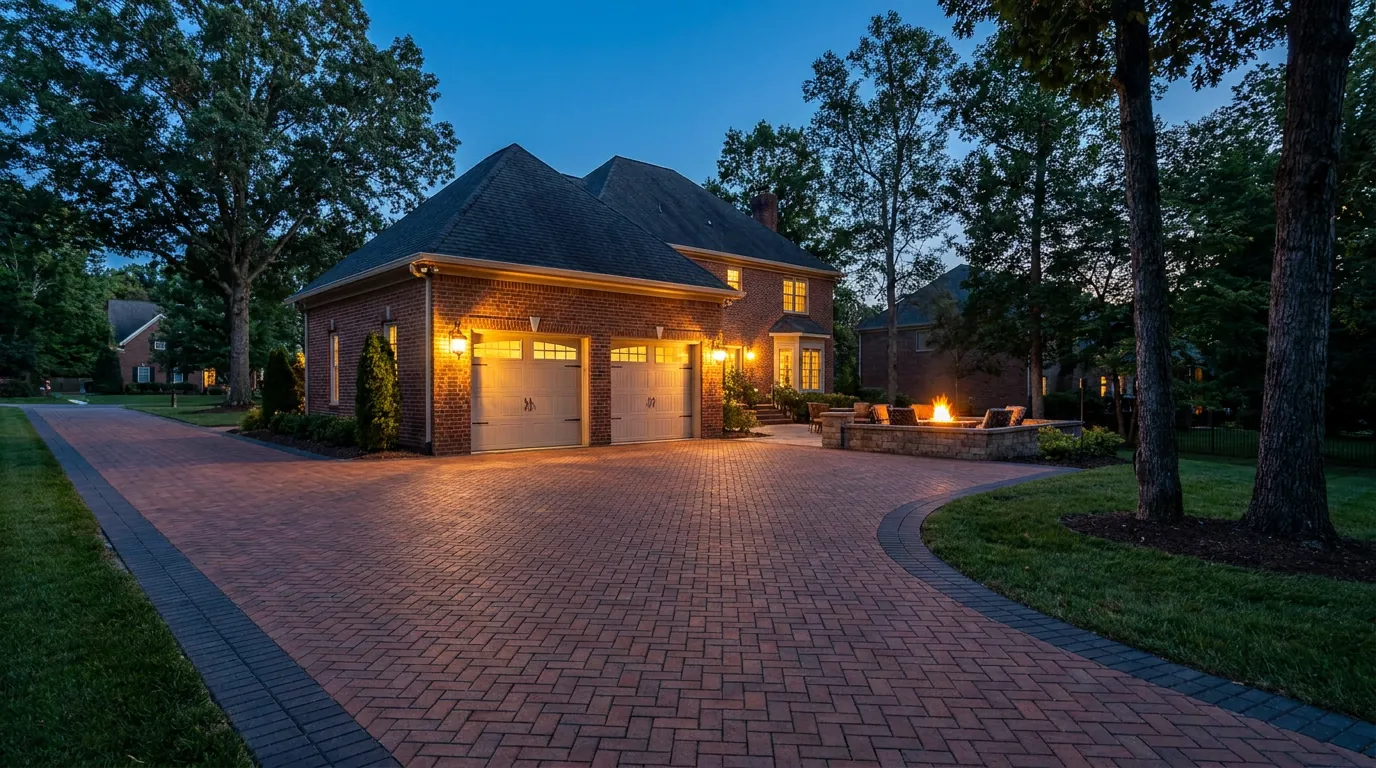
A paver driveway wants more stone under it than a patio: CMHA’s guidance starts residential driveways at 6 inches of compacted aggregate. Clay brick for heavy vehicle traffic is made to a different standard from patio brick, ASTM C1272, which requires freeze-thaw resistance. Either surface can be taken up and relaid over a repaired water or gas line, which a poured slab can’t.
What moves the cost of a driveway?
Length and width, how much old asphalt or concrete has to be broken out and hauled away, the grade up from the street, and the finish. A soft spot in the old base is work you pay for before any new surface goes down. A plain broom finish is the simplest surface to place; a paver or brick drive takes longer to lay, and a border or apron in a second material adds to it.
Concrete, pavers or brick?
Concrete is the fastest and the plainest. Pavers give a pattern and a surface that can be repaired a section at a time. Clay brick matches an older brick house and keeps its color for good. All three last on a base built for the load and a slope that sends water off the drive instead of into the garage.
Sources
- Tennessee Concrete Association, ACI 332 for driveways — minimum thickness and the Tennessee mix
- NRMCA Concrete in Practice 6, Joints in Concrete Slabs on Grade — control joint spacing
- CMHA Tech Note PAV-TEC-002 — residential driveway base
- ASTM C1272, Heavy Vehicular Paving Brick