
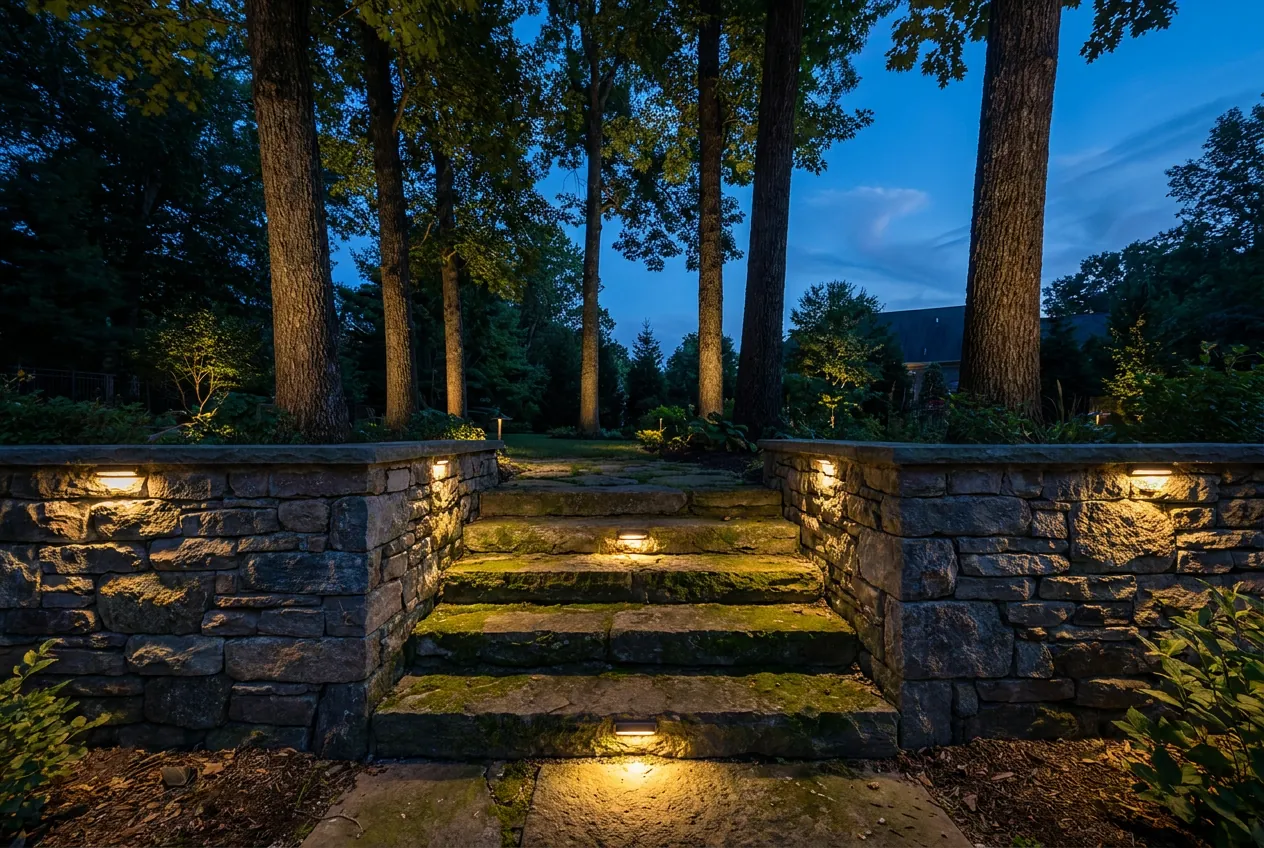
Low-voltage step lights and wall lights on natural stone steps and a retaining wall at night

Outdoor lighting · Nashville

Landscape lighting in Nashville

Low-voltage lights for steps, walls, paths and patios, aimed down and set where a foot needs them first.

How does low-voltage landscape lighting work?

A transformer plugged into an outdoor outlet steps the house’s 120 volts down to low voltage, usually 12, and sends it through direct-burial cable to each fixture. The cable can run shallow, in a slit along a bed, and a nicked wire isn’t the hazard it would be on a household circuit. LED lamps draw a fraction of what the old halogen bulbs did, so one transformer carries more fixtures.

What to light first

Steps, changes in level and the path to the door. A light in a step riser or under a wall cap puts light on the tread, where a foot lands. After that come the things worth seeing at night: a stone wall grazed from below, a tree, the seat wall around the fire pit, the edge of the deck.

Light that stays in the yard

A fixture aimed at the sky lights the neighbor’s bedroom and little else. DarkSky International’s 2025 packet for its approved-fixture program asks most fixture types to send 95 percent of their light below 80 degrees. Shielded fixtures aimed down keep the yard lit and the porch view of the night sky intact.

Building the lights into the hardscape

The best time to light a wall or a run of steps is while it’s being built. The cable goes in behind the units, the fixture sits in a cut block or tucks under the cap, and nothing is left lying on the ground. Lighting a finished wall means cutting into it, so when a patio, wall or walk is on the plan the lighting gets drawn with it.

Digging for the cable

A shallow trench is still excavation under Tennessee law. Tennessee 811 needs three working days’ notice before the first cut, even for a cable run along a flower bed.

Sources

Answers

Outdoor Lighting: questions people ask

How much does landscape lighting cost to install?

It runs by the fixture count, the transformer, the cable and the trenching. Lighting built into new walls and steps costs less to install than retrofitting finished hardscape, because the cable and fixtures go in while the work is open. Fixture material, brass or copper against painted aluminum, moves it too.

How much does landscape lighting cost to run?

Very little with LEDs. A low-voltage LED fixture typically draws a few watts, so a system of a couple dozen lights on a timer uses about what one or two old incandescent bulbs did. The transformer’s timer or photocell keeps them from burning all day.

How long does landscape lighting last?

LED lamps last far longer than the halogen bulbs they replaced, and brass or copper housings outlast painted aluminum outdoors. The weak points are the connections in the ground, so sealed connectors and cable run where shovels and mowers won’t find it keep a system working.

Is low-voltage landscape lighting safe?

Yes, that is the point of it. A transformer steps 120-volt house power down to about 12 volts, so the cable can be buried shallow and a nicked wire isn’t a shock hazard the way a household line is. The transformer plugs into a GFCI-protected outdoor outlet.

Where should landscape lights go?

Steps and changes in level first, then the path to the door, then the things worth seeing, like a stone wall, a tree or the fire pit. Aim fixtures down and shield them so the light stays on your property and out of the neighbors’ windows.

Request an Estimate

Start with the yard

Which steps, walls or paths you want lit after dark.

Where your message goes and what the site keeps: our privacy policy.

Email Request an Estimate